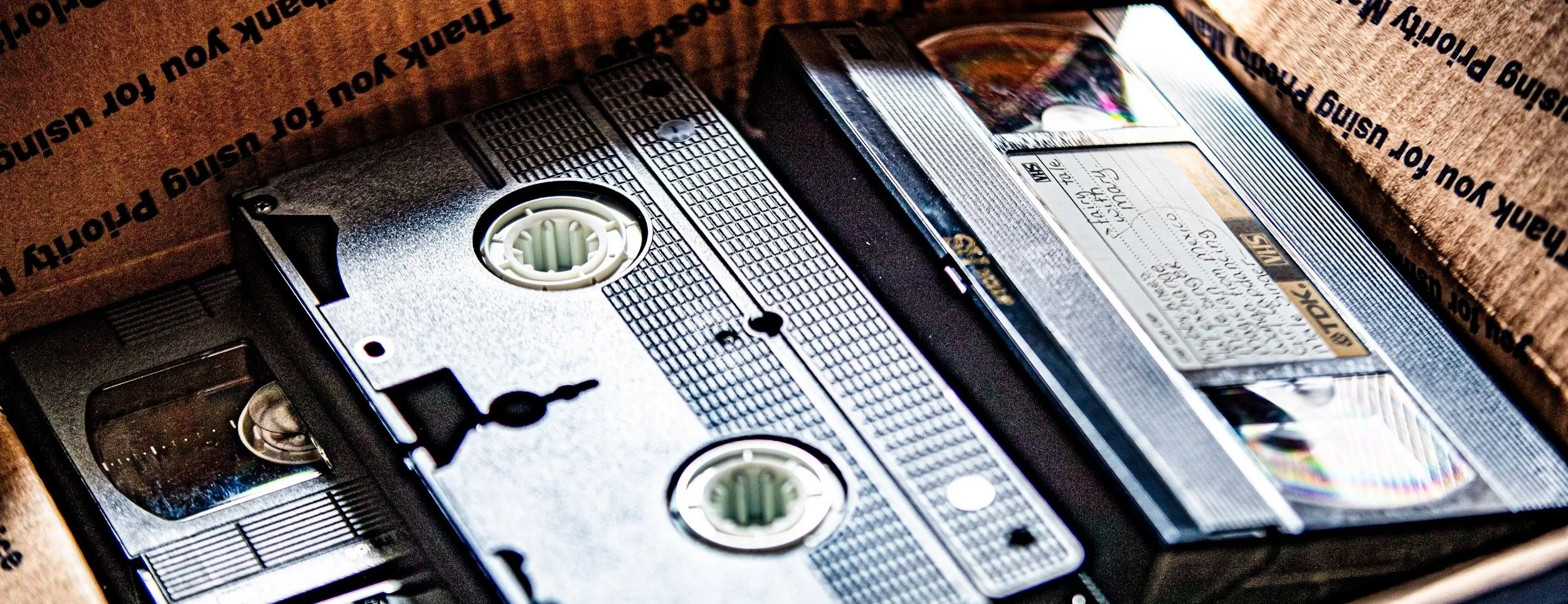
Preserve Your Home Movies — One Tape at a Time

VHS • VHS-C • MiniDV • 8mm • Hi8 • Digital8 • MicroMV — Digitized to MP4

Your family’s old videotapes hold moments that will never happen again.
We safely digitize every tape using high-quality, in-house transfer decks — right here in Mason City, IA.

Your tapes never leave our facility, and every transfer is handled with care and attention.

North Iowa & Southern Minnesota’s trusted video-to-digital service.

Get an Estimate
Schedule an Appointment

Call us with Questions

641.200.4190

🛡️ Trusted Local Service

Serving North Iowa & Southern Minnesota

Why North Iowa Families Trust SnapCache

🛡️ Secure, In-House Digitizing

Your tapes never leave Mason City

5-Star Google Rated

Safe, fast, and reliable


“Clients tell us they love our fast turnaround, clear communication, and the care we take with their family memories.”


Choose Your Tape Type

Quick pricing for every format

  • Standard 720P Transfer

    1–4 tapes: $25 each

    5–14 tapes: $22 each

    15+ tapes: $20 each

    Upscaled 1080P Transfer

    1–4 tapes: $35 each

    5–14 tapes: $32 each

    15+ tapes: $30 each

    Included With Every Transfer

    • Real-time digitizing (never high-speed dubbing)

    • Color and exposure balancing

    • Tracking stabilization

    • Removal of long blank sections (optional)

    • File naming + organization

    • Free cloud delivery

    • MP4 output (other formats available upon request)

      Optional Add-ons

      • USB Delivery:

        • Under 32GB — $5

        • 32GB — $10

        • 64GB — $15

        • 128GB — $20

      • Tape Repair / Splicing: $10 per tape

      • Enhanced metadata labeling: $0.05 per file

  • Standard 720P Transfer
    1–4: $40
    5–14: $37
    15+: $35

    Upscaled 1080P Transfer
    1–4: $60
    5–14: $57
    15+: $35

    Included With Every Transfer

    • Real-time digitizing (never high-speed dubbing)

    • Color and exposure balancing

    • Tracking stabilization

    • Removal of long blank sections (optional)

    • File naming + organization

    • Free cloud delivery

    • MP4 output (other formats available upon request)

      Optional Add-ons

      • USB Delivery:

        • Under 32GB — $5

        • 32GB — $10

        • 64GB — $15

        • 128GB — $20

      • Tape Repair / Splicing: $10 per tape

      • Enhanced metadata labeling: $0.05 per file

VIDEO TAPE DIGITIZING

Starting at $25 per tape
Blank, under 5 minutes, or unplayable tapes are free of charge.

All tapes are digitized in-house using dedicated playback decks — no outsourcing, no combo DVD/VHS machines, and no AI “guesswork.”
Your tapes never leave our Mason City facility, and every transfer is captured with care and precision.

INSIDE A VHS TAPE: HOW IT WORKS

VHS uses ½-inch magnetic tape coated in iron-oxide particles. It was durable for its time — but never meant to last forever.

Over 30–40+ years, VHS tapes naturally suffer from:

  • Loss of magnetic charge → color fade + static

  • Binder breakdown (“sticky-shed syndrome”)

  • Tape edge wear → wobble or tracking issues

  • Mold growth on the tape surface

  • Warping from heat or humidity

  • Dropouts — tiny missing sections of recording

Since VHS players stopped mass production in 2016, every year it becomes harder to find equipment capable of safe playback.

WHY DIGITIZING VHS IS SO IMPORTANT TODAY

Most home movies on VHS are now 30–45 years old — well beyond their intended lifespan.

Common symptoms you may already see:

  • Faded or tinted color

  • Snowy or flickering video

  • Audio dropouts

  • Tracking lines or jitter

  • Tape sticking inside the shell

  • Visible mold on the tape edge

Digitizing preserves your footage before natural decay or equipment failure makes playback impossible.

When we transfer your tapes:

  • Every tape is played on professional decks

  • No outsourcing, no cheap combo units

  • No AI “guessing” or altering your original footage

  • Your family’s memories stay right here in Mason City, IA

📼 TAPE TYPES WE SPECIALIZE IN

We professionally digitize:

  • VHS

  • VHS-C

  • MiniDV

  • 8mm Video

  • Hi8

  • Digital8

  • MicroMV

  • Betamax

  • ¾-inch U-Matic

Every format is captured at the highest quality your tape allows.

The History of Video tapes

VHS (Video Home System)
Introduced: 1976
Manufacturer: JVC (Victor Company of Japan)

VHS didn’t appear out of nowhere — its roots go all the way back to the 1950s, when video tape was first invented.

📜 The 1950s: The Birth of Video Tape Technology

Before the world ever heard of VHS, television networks needed a way to record and replay broadcasts. In 1951, engineers at Bing Crosby Enterprises (yes — the singer) successfully demonstrated the first magnetic video recorder, but image quality was extremely poor.

The breakthrough came in 1956, when Ampex introduced the VRX-1000, the first commercially viable video tape recorder (VTR).
This machine:

  • Cost as much as a house

  • Weighed over 1,000 pounds

  • Used 2-inch wide tape running at 15 inches per second

  • Was mainly used by TV stations, not consumers

This early tech proved that video could be recorded on magnetic tape — but making it small and affordable for families would take another two decades.

These early machines laid the technical foundation for every home video format that followed, including VHS.

📺 1960s–Early 1970s: The Push Toward Home Video

Throughout the 1960s, several companies tried to shrink broadcast-sized machines into consumer-friendly devices.

Sony introduced the CV-2000 in 1965 — the first home-use video recorder — but it used unusual tape sizes and never gained mass adoption.

By the early 1970s, two major formats were competing to become the world’s home video standard:

🔹 Sony’s Betamax (1975)

🔹 JVC’s VHS (1976)

Sony pushed for a tightly controlled ecosystem. JVC believed home video should be affordable, open, and accessible.

The stage was set for a technological “format war.”

📼 1976: VHS Is Born

JVC introduced the Video Home System (VHS) in 1976, engineered to meet three key goals:

  1. Affordable machines and tapes

  2. Longer recording time than Betamax

  3. Open licensing so any manufacturer could build VHS products

The resulting advantages were huge:

  • VHS offered 2–6 hours of recording time, compared to Betamax’s 1 hour

  • VHS machines were cheaper to build

  • Many manufacturers (Panasonic, Sharp, Hitachi, etc.) quickly supported VHS

  • Movie rental stores preferred the longer playtime

By the mid-1980s, VHS dominated 90% of the home video market.

🧪 Inside a VHS Tape: How It Works

VHS uses ½-inch magnetic tape coated in iron-oxide particles. While durable for its time, it was never meant to last forever.
Over 30–40 years, the following naturally occur:

  • Loss of magnetic charge → color fade + static

  • Binder breakdown → sticky-shed syndrome

  • Mold growth → playback damage

  • Tape edge wear → wobble or tracking issues

  • Warping from heat or humidity

Because VHS players stopped mass production in 2016, every year it becomes harder to find equipment capable of safe playback.

Why Digitizing VHS Is So Important Today

Your VHS tapes are now 30–45 years old — well past the intended lifespan of magnetic tape.

Common symptoms of aging include:

  • Snowy or flickering video

  • Audio dropouts

  • Tape sticking inside the shell

  • Visible mold

  • Color shifting toward blue, green, or red

Digitizing preserves your footage permanently, before natural decay or equipment failure makes playback impossible.

Alternative Tape Formats and History

📼 1. VHS-C

Introduced: 1982
Manufacturer: JVC
Purpose: A compact, portable VHS format for camcorders

After VHS dominated home video, JVC realized families needed a smaller, lightweight format for recording home movies. VHS tapes were too large and heavy to place inside shoulder-mounted camcorders, so JVC engineered VHS-C (“Compact VHS”).

🔹 What made VHS-C successful?

  • Used the exact same tape formulation as full-size VHS

  • Required only a simple adapter to play in any VHS VCR

  • Allowed camcorders to be small, battery-powered, and mobile

📐 Physical Characteristics

  • ⅓ the size of a standard VHS tape

  • Typically recorded 20–60 minutes depending on tape length

  • Despite small size, video quality was identical to VHS

⏳ Longevity & Problems Today

VHS-C uses thinner tape stock, so it is more prone to:

  • Wrinkles

  • Binder breakdown

  • Jamming inside the shell

  • Cracking hubs or leader detachment

Digitizing early prevents irreversible tape damage in these compact cartridges.

📼 2. MiniDV

Introduced: 1995
Developed by: Panasonic & Sony (DV consortium)
Purpose: High-quality digital recording for consumer and professional use

MiniDV marked a major leap from analog formats like VHS and Hi8 into true digital recording.

🔹 Why MiniDV was groundbreaking

  • Recorded in DV compression at 25 Mbps

  • Produced sharp, broadcast-quality picture

  • Became a standard for independent filmmakers, news reporters, and wedding videographers

📐 Format Characteristics

  • Extremely compact cartridge

  • Up to 60 minutes (SP) or 90 minutes (LP) recording time

  • Digital audio stored at 16-bit / 48 kHz

⏳ Aging & Modern Risks

Even though MiniDV is digital, it still suffers from dropout, tape stretching, and digital block artifacts as it ages.

Additionally, MiniDV camcorders are no longer manufactured, and parts are extremely scarce — making digitization urgent.

🎥 3. 8mm / Hi8 / Digital8

🕰 Origin: 1985 — Sony introduces 8mm Video

Sony wanted a smaller, lighter, higher-quality alternative to bulky VHS-C.

🟣 8mm Video (1985)

  • Analog format

  • Better picture than VHS-C

  • Allowed much smaller, handheld camcorders

  • Quickly became the “home movie standard” of the late 1980s

🔵 Hi8 (1989)

  • Higher bandwidth version of 8mm

  • Sharper image quality

  • Used heavily by schools, journalists, and hobbyist filmmakers

Digital8 (1999)

Sony wasn’t ready to abandon the millions of 8mm users, so instead of switching everyone to MiniDV, they created Digital8, which:

  • Recorded DV digital video

  • Could play back analog 8mm and Hi8 tapes (certain models)

  • Used the same 8mm tape stock but at higher speed

Digital8 became a transition technology bridging analog and digital video.

⏳ Decay & Risks Today

8mm-family tapes are among the most failure-prone:

  • Binder breakdown

  • Tape edge wear

  • Audio dropout

  • Mold growth in humid storage

  • Playback alignment issues

Digitizing restores stability and prevents the mechanical wear common in 8mm shells.

📼 4. Betamax

Introduced: 1975
Manufacturer: Sony
Claim to Fame: The VHS rival

Betamax arrived one year before VHS and arguably delivered better picture quality — but lost the “format war” for several reasons.

🔹 Why Betamax failed despite superior quality

  • Shorter recording time (1 hour vs. VHS’s 2–6 hours)

  • Sony tightly controlled licensing; VHS was open-source

  • VHS was cheaper to produce

  • Movie rental stores favored longer-play VHS titles

By the mid-1980s, VHS overtook Betamax globally.

📐 Characteristics

  • ½-inch tape (same width as VHS)

  • Higher resolution but less recording time

  • Used heavily by schools and semi-professional users

⏳ Preservation Notes

Betamax tapes age similarly to VHS, suffering:

  • Color loss

  • Magnetic fading

  • Dropouts

  • Sticky binder

With machines no longer produced, digitizing is essential.

📼 5. MicroMV

Introduced: 2001
Manufacturer: Sony
Purpose: The smallest tape-based camcorder format ever made

MicroMV tapes were 70% smaller than MiniDV and stored MPEG-2 compressed video.

🔹 Advantages

  • Extremely compact camcorders

  • Great for travel and casual shooters

🔹 Disadvantages

  • Proprietary format

  • Limited compatibility

  • Heavy compression

  • Very few playback decks exist today

MicroMV tapes are now very difficult to digitize because:

  • Camcorders are rare

  • The format was discontinued in 2006

  • Playback heads easily misalign

Digitizing MicroMV is urgent due to scarce equipment.

📼 6. U-Matic (¾-inch)

Introduced: 1971
Manufacturer: Sony
Purpose: Professional and educational video recording

Before VHS ruled homes, ¾-inch U-Matic dominated:

  • TV news stations

  • Schools and universities

  • Corporate training departments

  • Industrial video production

🔹 Why U-Matic was important

It was the first truly portable videotape system, enabling field recording for journalists.

U-Matic was available in three main types:

  • Low-Band (education, early use)

  • High-Band (broadcast)

  • SP (Superior Performance)

🧰 Tape Characteristics

  • ¾-inch tape

  • Large, rugged cassette

  • Better durability than consumer formats

⏳ Failure Points Today

U-Matic tapes often suffer:

  • Severe binder breakdown (“sticky-shed syndrome”)

  • Oxide shedding

  • Mechanical sticking

  • Playback deck scarcity

Digitization is highly recommended due to these age-related risks.

Your Home Movies are not getting any Younger

No really… they’re literally fading while you read this. blink blink
Ready when you are.

Get an Estimate
Text Or Call Us today