
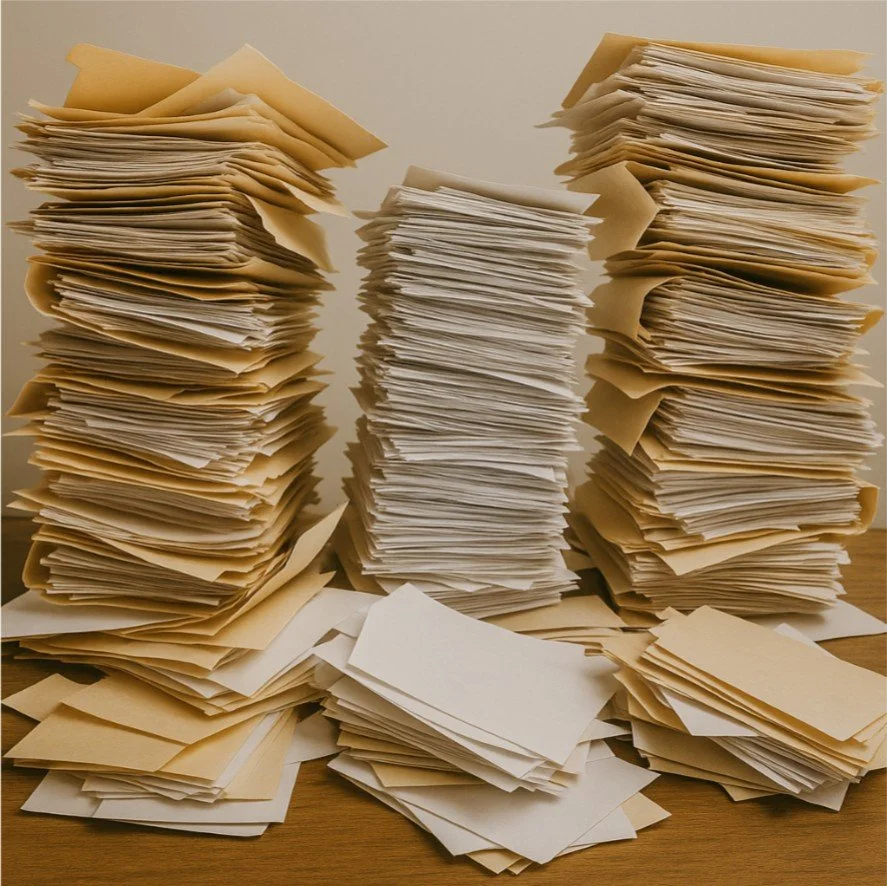
PRESERVE YOUR IMPORTANT DOCUMENTS
Birth certificates • Letters • Legal records • Photos • Scrapbooks • Artwork • Manuals • Business files • Manuscripts
Your documents hold memories, meaning, and history, but paper doesn’t last forever.
We digitize every page with precision, clarity, and care, right here in Mason City.
Your originals never leave our facility, and every scan is captured using professional-grade flatbed and feed scanners for accurate, archival-quality digital files.
Northern Iowa & Southern Minnesota’s trusted document scanning service.
641-200-4190
Over 15,000 memories preserved
〰️
Over 1000 hours of video digitized
〰️
Locally owned and operated
〰️
No Shipping Required!
〰️
Over 15,000 memories preserved 〰️ Over 1000 hours of video digitized 〰️ Locally owned and operated 〰️ No Shipping Required! 〰️
⭐ 5-Star Google Reviews
A reputation built on great service
Supporting Families & Businesses Across North Iowa


Choose Your document Type
Quick pricing for every format
-
Pricing:
1–199 pages: $0.12/page
200–999 pages: $0.10/page
1000+ pages: $0.08/page
-
Pricing:
1–199 pages: $0.25/page
200–999 pages: $0.20/page
1000+ pages: $0.15/page
-
Pricing:
1–199 pages: $0.75/page
200–999 pages: $0.60/page
1000+ pages: $0.50/page
Ouput as fully editable PDF, or Word format.
HOW WE SCAN YOUR DOCUMENTS
AUTOMATED FEED SCANNING
Used for:
Standard office papers
Bills, letters, and correspondence
Multi-page documents
Non-fragile pages
Benefits:
High-speed, consistent quality
Ideal for bulk scanning
Clean, uniform digital files
OVERSIZED DOCUMENT SCANNING
Used for:
Certificates
Drawings
Artwork
Large documents that won’t feed through a scanner
Benefits:
High-resolution capture
No tearing or bending
Ideal for heirloom papers
OUTPUT OPTIONS
PDF (multi-page or single-page)
High-quality JPGs
TIFF (archival)
OCR text extraction (optional)
OCR notes:
Great for searchable text
Works best on clean, typed documents
Handwriting will be captured as image only
FLATBED SCANNING
Used for:
Fragile or crumbling papers
Old letters, postcards, journals
Bound items such as scrapbooks or albums
Photos or mixed-media pages
Anything curled, thick, or delicate
Benefits:
Page-by-page care
Accurate reproduction of color, texture, and ink
Safest method for fragile originals
WHY DIGITIZING DOCUMENTS IS SO IMPORTANT
Paper breaks down — faster than most people realize.
Common aging issues include:
Yellowing and fading
Acidic paper decay
Ink smearing or disappearing
Tears, folds, and brittle edges
Mold exposure
Staples, tape, and adhesive damage
Digitizing now prevents permanent information loss, ensures long-term preservation, and makes your documents easily shareable with family or business partners.
Why Document Preservation Matters More Than Ever
Every document tells part of a family's story.
Whether it's a handwritten letter from a grandparent, military discharge papers, an old family Bible, a child's report card, or decades of business records, these documents connect generations in ways that cannot be recreated.
Digitization protects against:
Fire
Flood
Mold
Insect damage
Sunlight
Accidental tearing
Misplacement during moves
Chemical decay
Aging paper fibers
Unlike paper, a properly archived digital copy can be duplicated, backed up, organized, and shared without causing further wear to the original.
Preserving the Past for Future Generations
For thousands of years, humanity has relied on physical documents to record history, preserve knowledge, and tell personal stories. From clay tablets and handwritten manuscripts to family letters and modern records, every generation has entrusted its memories to the materials available at the time.
Today, digitization is the next step in that long tradition. By preserving documents before age, moisture, and time take their toll, families can ensure that irreplaceable records remain accessible for children, grandchildren, and generations yet to come.
Your documents are at risk
What would you do if you lost your important documents in a fire, flood or other disaster?
Protect them now by clicking below